



Introduction
In today’s volatile market, managing a real estate portfolio across multiple regions and asset classes is no longer a task for spreadsheets. For institutional investors and family offices, the challenge isn't tracking a property; it’s understanding the performance of the entire portfolio as a single, cohesive investment.
Fragmented data—where leasing income lives in one app and sales revenue in another—is the "visibility killer" of 2026. To stay competitive, firms are shifting toward real estate investment portfolio management software that offers a unified "Single Source of Truth."
Why Traditional Property Management Falls Short
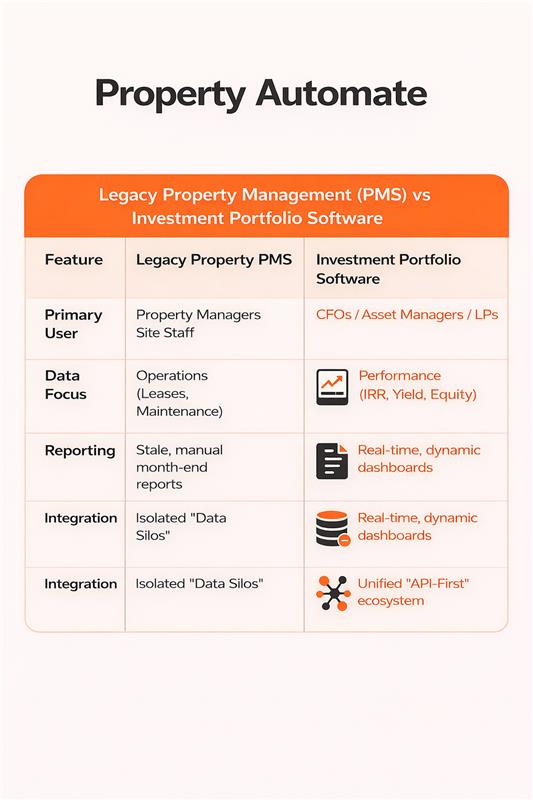
Most legacy systems are built for operators, not investors. While property management tools handle the day-to-day (such as fixing a boiler or collecting rent), they often lack the high-level financial modelling required for strategic growth.
- Data Silos: Leasing, sales, and accounting data often live in three different silos.
- Delayed Reporting: Manual consolidation leads to reports that are "stale" by the time they reach the board.
- Inaccurate Valuations: Without real-time market data integration, your portfolio's net worth is often a guess.
The Shift Toward "Investment-First" Portfolio Visibility
Modern real estate leaders are moving beyond operational tracking. They are adopting a portfolio-first approach, treating real estate with the same analytical rigor as a stock or bond portfolio.
Key Metrics for 2026 Investors:
- Portfolio-Wide NOI (Net Operating Income): Aggregating leasing and sales revenue instantly.
- Dynamic Yield & ROI: Tracking performance against original acquisition costs in real-time.
- Historical Valuation Trends: Comparing asset appreciation across different cycles.
How Real Estate Portfolio Management Software Drives ROI
The primary role of this software is to bridge the gap between operational chaos and investment intelligence.
1. Unified Investor Dashboards
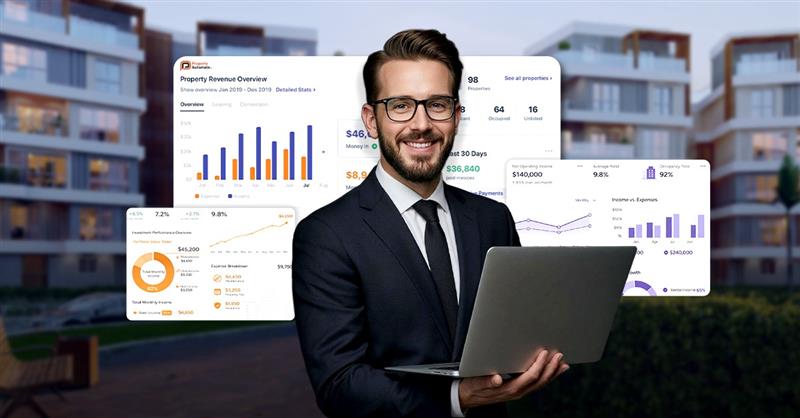
Dashboards like those in PortfolioGOTO provide stakeholders with high-level summaries. Instead of digging through rent rolls, a Family Office Principal can see the total portfolio yield and risk exposure in a single view.
2. Automated Professional Reporting
In 2026, transparency is a currency. Investors expect professional, data-backed reports at the click of a button. Modern platforms automate the generation of monthly and quarterly performance summaries, building trust and reducing administrative overhead.
3. Benchmarking and Capital Allocation
By centralizing data, you can easily identify "Underperformers" vs. "Alpha Generators." This allows leadership teams to make data-driven decisions on where to divest and where to double down.
Where PortfolioGOTO Fits Into Your Tech Stack
As portfolios scale, you need a platform that focuses on Investor-Level Analysis. PortfolioGOTO doesn't replace your accounting system; it supercharges it.
By unifying leasing and sales performance, it provides:
- Real-time ROI and Yield analysis.
- Read-only access for stakeholders to ensure transparency.
- Strategic insights without the "operational noise."
Final Takeaway: Intelligence is a Requirement, Not an Option
The gap between successful real estate firms and those struggling to scale is Portfolio-Level Intelligence. By investing in dedicated real estate investment portfolio management software, you move from reactive reporting to proactive, data-driven leadership.
FAQ's
1. What is real estate portfolio management software?
It is a centralized platform that aggregates financial, operational, and market data across multiple properties to give investors a unified view of ROI, NOI, and valuation growth.
2. Who needs real estate investment portfolio management software?
It is designed specifically for B2B organizations such as family offices, REITs, institutional investors, and property developers managing complex, multi-asset portfolios.
3. How does it differ from a standard Property Management System (PMS)?
A PMS handles daily operations (maintenance, rent collection), whereas portfolio management software focuses on investment performance, financial modeling, and stakeholder reporting.
4. Can I integrate this with my existing accounting software?
Yes. Modern platforms like PortfolioGOTO are designed to complement ERPs and accounting tools by pulling their data into high-level investor dashboards.
5. What are the top features to look for in 2026?
Look for real-time ROI tracking, automated investor reporting, multi-currency support, and AI-driven predictive valuation models.