



The Shift to Agentic AI for Real Estate
By 2026, the property management industry has hit a "data wall." With thousands of IoT sensors, digital leases, and tenant communications generated daily, human teams can no longer process the volume manually. The traditional reactive workflow fixing things after they break—is now a liability.
Forward-thinking firms are adopting AI agents for property management to bridge this gap. This shift from manual automation to Agentic AI means moving toward a future where property systems don’t just alert you to problems; they resolve them autonomously before they impact your P&L.
What are AI Agents for Property Management?
AI agents are intelligent software entities designed to execute complex, multi-step workflows with minimal human oversight. Unlike basic automation (which follows "If-This-Then-That" rules), agentic AI for real estate can reason, plan, and interact with different software layers to achieve a goal.
Key Capabilities of Real Estate AI Agents:
- Autonomous Reasoning: They analyze context, such as comparing a tenant's history with current local rental laws.
- Cross-Platform Execution: They can move from a maintenance request in a tenant portal to scheduling a vendor in an ERP system.
- Predictive Learning: They identify patterns in utility spikes or lead drop-offs to suggest proactive fixes.
The Cost of Reactive Property Management
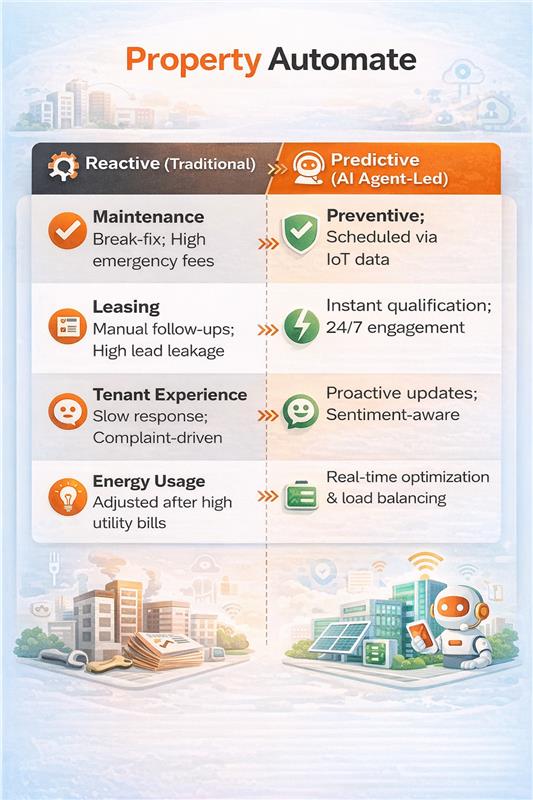
In a competitive 2026 market, relying on reactive workflows leads to "Operational Hemorrhage." The table below compares the old model with the new AI-driven predictive model:
4 Ways AI Agents Enable Predictive Operations
1. Predictive Maintenance & Asset Intelligence
AI maintenance agents analyze historical service data and real-time sensor inputs. By predicting when an HVAC unit or elevator is likely to fail, they initiate work orders weeks in advance, reducing emergency repair costs by up to 20%.
2. Agentic AI for Leasing and Sales
Leasing is now a 24/7 operation. AI agents for property management monitor lead behavior across listings and social media. They don't just send "canned" emails; they qualify high-intent prospects and schedule tours based on the leasing team’s real-time availability.
3. Proactive Tenant Experience
Tenant retention is the key to ROI. AI agents monitor tenant sentiment by analyzing communication speed and feedback trends. If a tenant’s satisfaction score dips, the agent can automatically flag them for a "loyalty check-in," preventing turnover before the lease ends.
4. Smart Financial Orchestration
AI agents can now manage complex trust accounting, reconciliations, and tax compliance. By integrating with platforms like Property Automate and orchestration tools like AgentGoto, they ensure financial accuracy without the need for manual data entry.
Building a Predictive Stack in 2026
To achieve top-tier efficiency, property managers must move away from "Siloed Tech" and toward an AI Orchestration Platform.
- Centralize Data: Use a unified database (like Property Automate) as the "brain."
- Deploy Agents: Introduce specialized AI agents for maintenance, sales, and finance.
- Human-in-the-Loop: Set "thresholds" where the AI agent handles routine tasks but escalates high-value decisions to human managers.
Conclusion
The transition from reactive to predictive is no longer a choice—it is a survival strategy. AI agents for property management allow businesses to scale without doubling their headcount, providing a level of visibility and control that was impossible five years ago.
By embracing Agentic AI for real estate, you aren't just buying s oftware; you are building a resilient, future-ready ecosystem that protects your assets and delights your tenants.
Frequently Asked Questions (FAQ)
1. What is the difference between AI automation and AI agents?
Traditional automation follows pre-set rules. AI agents use "agentic" reasoning to handle unpredictable variables and make decisions based on the context of the situation.
2. How do AI agents for property management save money?
They reduce costs by predicting equipment failures (avoiding emergency fees), automating lead nurturing (reducing vacancy periods), and optimizing energy consumption in real-time.
3. Can AI agents integrate with my existing CRM?
Yes. Modern agentic AI platforms like AgentGoto are designed to sit on top of your existing tech stack, connecting your CRM, ERP, and maintenance tools into one intelligent workflow.
4. Are AI agents for property management secure?
Reputable platforms in 2026 use enterprise-grade encryption and comply with global data privacy regulations (like GDPR and CCPA) to ensure tenant and owner data remains protected.
5. How does AI improve the tenant experience?
By providing 24/7 instant communication, faster maintenance resolutions, and proactive problem-solving, AI agents create a seamless living experience that increases tenant retention.