




Introduction
The United Arab Emirates real estate landscape is moving at unprecedented speeds. From high-rise commercial towers in Dubai’s Business Bay to vast residential master developments in Abu Dhabi, property leaders face escalating operational costs, rising tenant expectations, and strict regulatory requirements like Mollak compliance.
Traditional enterprise resource planning systems (ERPs) and legacy databases are no longer enough. To maintain high occupancy, protect net operating income (NOI), and deliver premium occupant experiences, forward-thinking real estate organizations are turning to AI property management software in the UAE.
By embedding artificial intelligence, predictive analytics, and automated workflows into everyday operations, modern property technology enables asset management teams to transition from reactive troubleshooting to proactive portfolio optimization.
The Shift to Intelligent Real Estate Operations in the UAE
Managing real estate in the Gulf region presents distinct challenges. Asset managers must balance high tenant turnover, complex service charge allocations, harsh climatic stress on physical assets, and tight governance frameworks.
AI is reshaping property management by replacing manual, reactive processes with smarter, connected operations. From automated lease and contract ingestion to predictive IoT maintenance, omnichannel resident engagement, and real-time cash flow analytics, AI-powered property technology helps teams reduce manual effort, improve response times, strengthen financial visibility, and make faster, data-driven decisions.
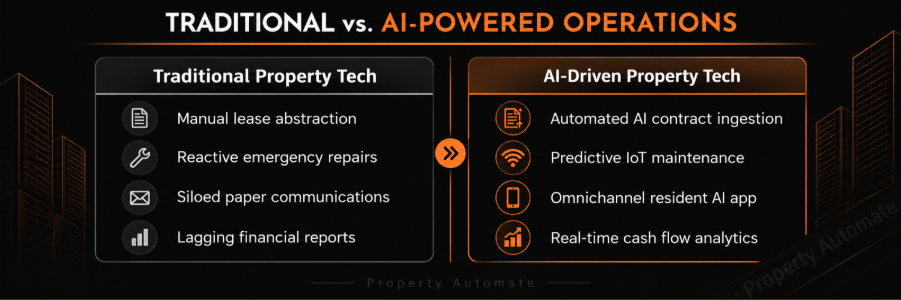
AI property management software bridges the gap between disparate operational units. Instead of relying on disconnected spreadsheets and manual entry, intelligent platforms analyze historical portfolio data to forecast maintenance bottlenecks, automate lease renewals, and optimize utility consumption across mixed-use portfolios.
Key Core Modules of AI Property Management Software
An enterprise-grade property platform delivers targeted automation across every tier of asset management.
1. Automated Leasing and Smart Contract Lifecycles
Lease administration often creates operational bottlenecks for leasing heads and admin teams.
- AI Lease Abstraction: Ingests complex commercial and residential lease agreements, automatically extracting critical terms, escalation clauses, and renewal dates into structured data formats.
- Dynamic Pricing Engine: Analyzes regional real estate market trends, seasonal demand, and historical occupancy rates across Dubai and Abu Dhabi to recommend optimal rental rates.
- E-Signatures and Payment Gateways: Integrates directly with UAE payment systems, enabling digital lease execution, automated direct debits, and instant security deposit processing.
2. Predictive Maintenance and Smart Facilities Management
Facility heads and engineering leaders can shift from costly emergency breakdowns to scheduled, predictive interventions.
- IoT Sensor Integration: Continuously monitors structural health, HVAC performance, and water networks across buildings to flag anomalies before major system failures occur.
- Automated Work Order Dispatch: Generates digital work orders based on tenant app requests or hardware alarms, automatically assigning jobs to relevant internal technicians or third-party vendors based on availability and SLAs.
- Vendor & Tender Tracking: Evaluates contractor performance metrics, tracks invoice approvals, and ensures maintenance activities stay within pre-approved operational budgets.
3. Integrated Finance and Regulatory Compliance
Financial transparency is vital for property management firms, Owner Associations (OAs), and institutional landlords operating in the UAE.
- Automated Service Charge Collections: Calculates, bills, and tracks community service charges while issuing automated, personalized collection reminders to unit owners.
- Regulatory Compliance: Designed to align with regional standards—such as integrating seamlessly with Dubai Land Department’s (DLD) Mollak system for transparent escrow and service charge management.
- Real-Time Financial Reporting: Generates instant unit-level P&L statements, tracks rent receivables, and flags payment defaults in a centralized dashboard.
Specific Use Cases for UAE Real Estate Decision-Makers
Different leadership roles extract distinct strategic benefits from an AI-driven management platform:
Centre Heads and Property Directors
Gain end-to-end portfolio visibility. Executive dashboards aggregate key performance indicators (KPIs)—including yield per square meter, overall portfolio occupancy, total cost of occupancy (TCO), and real-time revenue collection—allowing executives to make data-backed portfolio decisions.
Facility and Admin Heads
Streamline physical building operations while reducing energy consumption and operational expense (OpEx). Automated ticketing, maintenance scheduling, and central vendor repositories give admin and facility teams complete control over vendor performance and lifecycle tracking.
Community Managers and Tenant Experience Leaders
Deliver branded mobile app experiences for residents and commercial tenants. Occupants can submit maintenance requests, log visitor permits, book shared amenities, and make digital payments, directly boosting tenant retention and overall satisfaction scores
IT Heads and Systems Engineers
Replace legacy infrastructure with cloud-native, open-API architecture. Modern software connects smoothly with enterprise ERPs (such as Microsoft Dynamics 365, SAP, or Oracle) while keeping tenant data securely managed and fully compliant with local UAE data sovereignty standards.
Tailored Capabilities: Dubai vs. Abu Dhabi Markets
While the underlying technology remains flexible, real estate execution varies by region across the emirates.
Property Management Software in Dubai
Dubai’s fast-paced commercial and residential rental market demands rapid tenant onboarding, high-turnover lease tracking, and deep integration with digital government initiatives. AI platforms speed up tenancy registration, streamline short-term and long-term rental contracts, and assist with localized compliance frameworks across master developments in Downtown Dubai, Business Bay, and Dubai Marina.
Property Management Software in Abu Dhabi
Developments across Abu Dhabi—such as Yas Island, Saadiyat Island, and Al Reem Island—focus heavily on large-scale master community governance, owner association management, and long-term asset sustainability. AI property software helps community managers oversee multi-phase infrastructure, maintain shared amenity schedules, and transparently handle service charge budgets across expansive residential communities.
Evaluating Your Tech Stack: Features to Look For
When selecting an AI property management software for UAE portfolio operations, ensure the platform ticks these essential boxes:
- Regional Regulatory Readiness: Built-in alignment with local land department standards, escrow requirements, and property registration workflows.
- Open API Ecosystem: Seamless two-way integration with existing finance software, CRM tools, and smart building management systems (BMS).
- Multi-Language Support: Dual Arabic and English interfaces for both back-office administrators and tenant-facing mobile applications.
- Advanced Analytics Engine: Machine learning models capable of delivering actionable insights into tenant retention patterns, utility waste, and cash flow projections.
- Flexible Deployment Models: Scalable SaaS or enterprise cloud options configured to adapt as your total managed square footage grows.
Frequently Asked Questions (FAQs)
What is AI property management software, and how does it work in the UAE?
AI property management software is a centralized digital platform that uses artificial intelligence, machine learning, and smart automation to manage property portfolios. In the UAE, it automates core real estate tasks such as lease abstractions, predictive facility maintenance, service charge collection, tenant communications, and regulatory reporting for markets like Dubai and Abu Dhabi.
How does property management software in Dubai handle local compliance?
Modern property software built for the UAE market integrates with local systems and regulatory guidelines, such as the Dubai Land Department’s Mollak platform. This ensures service charge approvals, rental escrow management, and tenant notifications remain fully compliant with regional real estate governance laws.
Can community management software in Abu Dhabi help lower operational costs?
Yes. Community management software reduces operational costs by replacing manual admin processes with automated workflows. Predictive maintenance flags equipment issues before costly breakdowns occur, while automated service charge billing speeds up collections and reduces overall default rates across large master developments.
How does AI improve predictive maintenance for facility heads?
AI analyzes data from IoT building sensors, historical repair logs, and asset age metrics to predict when equipment like HVAC units, elevators, or water pumps are likely to fail. This allows facility heads to schedule targeted preventive maintenance, avoiding emergency repair costs and reducing tenant disruption.
Is AI property software capable of integrating with existing enterprise ERPs?
Yes. Leading B2B property management solutions feature open APIs that connect directly with enterprise ERPs, including Microsoft Dynamics 365, SAP, and Oracle. This ensures accounting, HR, and asset management teams operate from a single, unified source of data without manual data transfer.